TruAge vs TallyAge: two checks before you choose
Check that Tally still sells the kit. When checked on October 30, 2026, Tally’s test-kit page and membership page both returned a not-found error2425. Its home page now describes the TallyAge test only as a membership benefit, sent every six months, and shows no price10. Its help center still says you can order a single test6.
We found no published study that tests TruAge and TallyAge on the same people. They use different clocks and different tissue, and Tally’s help center says it isn’t unusual for two epigenetic age tests to give different results13. Even one test repeated can move: Tally says fluctuations of around two years between tests are normal11. Treat each number as one estimate from one test.
TruAge vs TallyAge side by side
None of these figures is evidence of a health or longevity effect. Prices are US list prices on each maker’s official pages, checked November 6, 2026 for TruAge and October 23 for TallyAge. Every figure is the maker’s own unless a study is named. ‘Not stated’ means the maker didn’t publish it.
| Question | TruDiagnostic TruAge (finger-prick kit) | Tally Health TallyAge (cheek-swab kit) |
|---|---|---|
| Best for | Several aging scores from one finger-prick kit | A cheek swab instead of a blood sample |
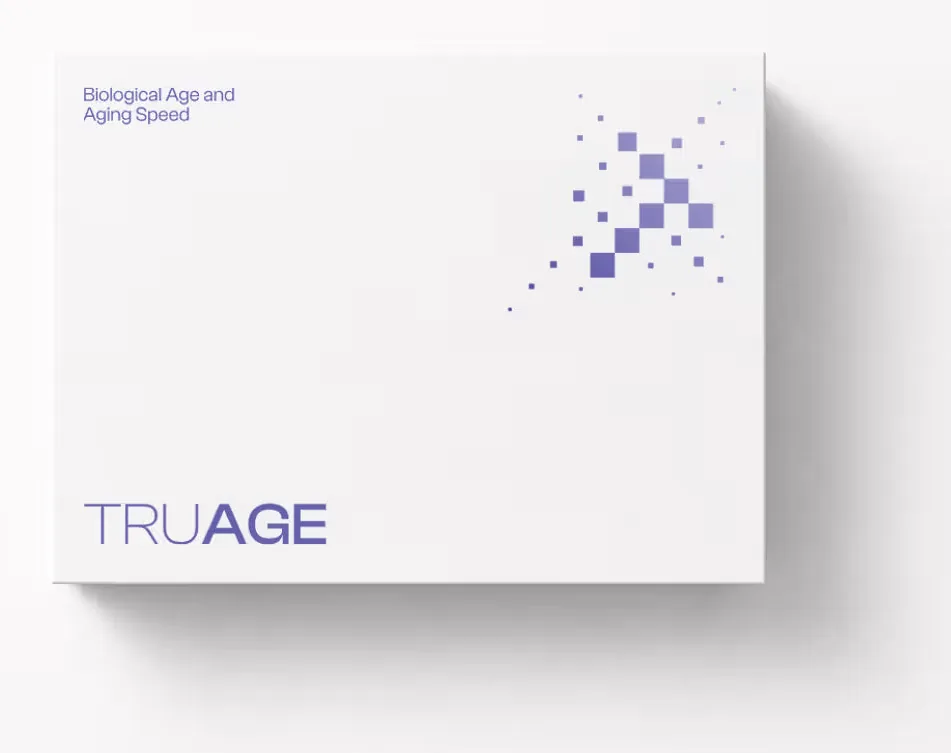
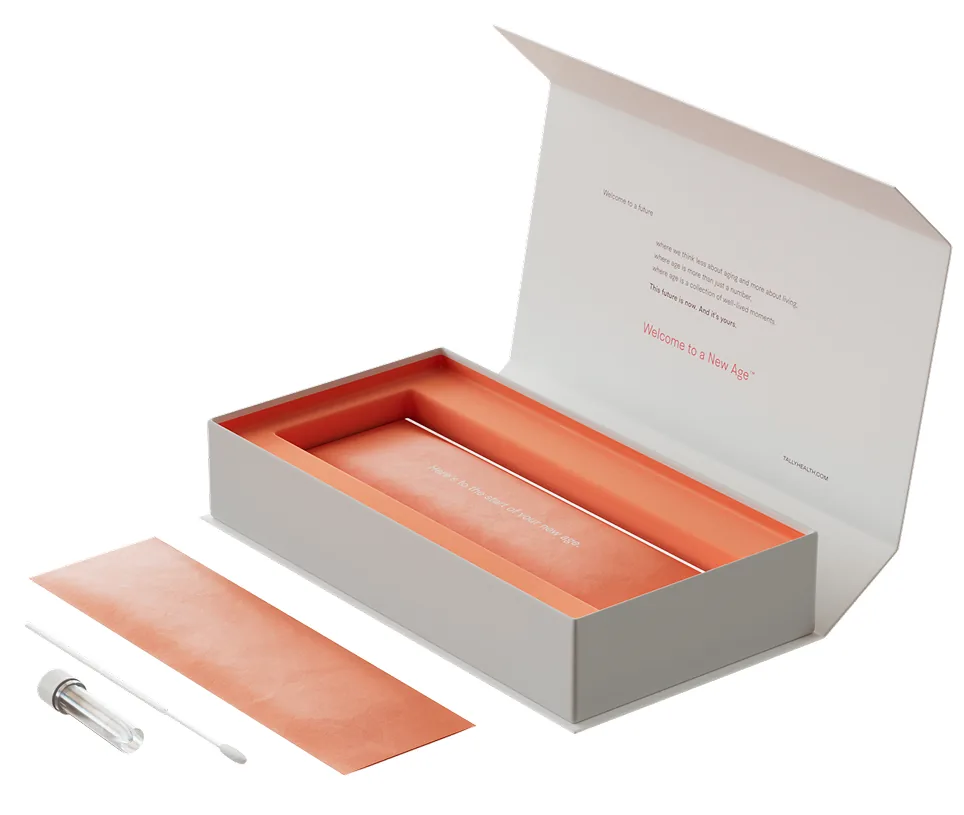
| Sample | A few drops of blood from a finger prick at home, returned in a prepaid USPS envelope1 | A swab of the inside of your cheek at home, registered online and mailed back with a prepaid return label67 |
| What it reports | OMICmAge biological age, DunedinPACE pace of aging, 11 organ-system ages (TruDiagnostic’s page is unclear on whether the kit includes them), telomere length, an immune cell report, an inflammation score (epigenetic CRP and IL-6), grip strength and gait speed, and smoking and alcohol impact scores12 | One epigenetic age, called TallyAge10. Tally’s home page and help articles don’t mention a pace-of-aging score or organ-system ages1013 |
| US price | $499 for the one-time kit, checked Nov 6, 2026. TruDiagnostic doesn’t state shipping1 | $249 for a single test with free shipping, checked Oct 23, 20266. Tally’s test-kit page returned a not-found error on Oct 3024 |
| Price and where to buy | $499US price, checked Check price at TruDiagnostic for TruDiagnostic TruAge Test | $249US price, checked Tally’s test-kit page returned a not-found error when checked on Oct 30, 2026. Check tallyhealth.com before ordering. |
| Retests | A $998 annual plan with 4 tests, about $249.50 a test, billed up front and renewing every year2. TruDiagnostic says many customers retest every 3 to 6 months1 | A membership sends a test every six months, billed monthly9, with a daily supplement and an action plan10. Tally’s membership page listed $129 a month when checked Oct 20, 202625 |
| Turnaround | 3 to 4 weeks after the lab receives your sample1 | 6 to 8 weeks in all, or 4 to 6 weeks after the lab receives your sample8 |
| Lab | CLIA-certified, per TruDiagnostic. The page doesn’t mention CAP accreditation or FDA clearance1 | Not named. Tally’s home page says only that a lab team processes the kit, and its privacy policy says samples are analyzed by Tally, affiliated labs, contractors and vendors. Tally doesn’t say whether its lab holds CLIA or CAP status1016 |
| Clock behind it | OMICmAge, built with Mass General Brigham data (Nature Aging, 2026), and DunedinPACE, from the Dunedin Study (eLife, 2022)1718 | CheekAge, built on cheek swabs from 8,045 adults (GeroScience, 2024). Tally’s help center calls that paper the foundation for its clock1319 |
| Repeat-sample reliability | 98% test-retest reproducibility per TruDiagnostic, with no study named1. OMICmAge’s paper reports an ICC of 0.998 across 30 replicate blood samples, and DunedinPACE’s reports 0.96 in a research dataset1718 | A mean replicate error of 0.85 years for CheekAge’s full model, and 1 year cross-validated, in its paper19. Tally says fluctuations of around two years between tests are normal and suggests at least five to nine tests to see a trend11 |
| Mortality research | OMICmAge and DunedinPACE were both linked to death in research cohorts, using blood1718 | CheekAge was linked to death in blood from 1,513 older adults, with a hazard ratio of 1.21 per standard deviation. We found no study that follows it from cheek swabs20 |
| Who wrote the research | TruDiagnostic employees are among OMICmAge’s authors, and some DunedinPACE authors are listed as inventors on a licensed invention1718 | All authors of the CheekAge paper work for Tally. Four of the six authors of the blood study are current or former Tally employees1920 |
| Owner | TruDiagnostic, part of Infinite Epigenetics, which bought Tally Health in a deal announced April 29, 202623 | Tally says it is a brand owned and operated by IE Tally Holdings, an affiliate of TruDiagnostic15 |
| Data terms | Privacy policy dated Sept 12, 2022. TruDiagnostic says it will ask for your consent before sharing individual-level epigenetic data with third parties, other than service providers it needs to deliver the service. Stored samples are discarded if you delete your account4 | Privacy policy and terms dated Apr 29, 2026. Tally says it doesn’t sell personal information, may share it with corporate affiliates, and may keep information about your sample for future research1516 |
| Refunds | All sales are final once the order ships. A free replacement kit if a sample fails for reasons outside your control, and a full refund if two samples fail because of lab error3 | Returns of unused items in the original packaging, with proof of purchase, after you email Tally first. No return window is stated, and the policy doesn’t mention test kits. Membership fees are non-refundable1415 |
| Who can buy | You must be 18 or older to give a blood sample. TruDiagnostic says it isn’t licensed in every jurisdiction and doesn’t offer its services in some5 | Residents of the 50 states and DC who are 18 or older15 |
| Diagnostic status | TruDiagnostic’s terms say its services are for research, informational and educational use only5 | Tally’s terms say its products do not constitute a diagnostic test15 |
These links go to each brand’s own store and earn us no commission.
Which epigenetic age test suits you
Each suits a different need, and this isn’t a ranking. Both send a result to an online account18, and neither presents itself as a diagnosis515. They differ in the sample you give, how many scores you get, what a retest costs and how much you can get back.
- Several aging scores from one finger-prick kit: TruAge. TruDiagnostic lists an OMICmAge biological age, a DunedinPACE pace of aging and telomere length, plus 11 organ-system ages that its page is unclear on whether the kit includes12. Results arrive 3 to 4 weeks after the lab receives your sample1. The trade-off: the annual plan is billed up front and renews every year2.
- A cheek swab instead of a blood sample: TallyAge. You get one epigenetic age, with free shipping and a prepaid return label610. Results take 4 to 6 weeks after the lab gets your sample8. The trade-off: a retest costs the same again unless you join the membership69.
What each test reports
TruDiagnostic lists nine reports for TruAge: an OMICmAge biological age, 11 organ-system ages, a DunedinPACE pace of aging, telomere length, an immune cell report, an inflammation score, grip strength and gait speed, and smoking and alcohol impact scores1. It says it analyzes 1,000,000+ DNA methylation sites and reports 75+ biomarkers1. DunedinPACE is a rate: TruDiagnostic describes it as how fast you’re aging compared with a single calendar year1.
Two details are unclear. TruDiagnostic’s page says organ-system ages come with a purchase of ‘TruAge COMPLETE’, while the page title reads ‘TruAge Test’1. The page also doesn’t say whether telomere length is measured or estimated from methylation, and it labels the CRP and IL-6 scores ‘epigenetic’1.
Tally calls its result TallyAge and describes it as an indicator of how you’re aging on a biological level, built from DNA methylation in adult cheek cells10. You view results online, with a Results History for past tests8. The Tally pages we read list one number and no pace-of-aging score, organ-system ages or telomere length1013.
The research behind TruAge’s clocks
DunedinPACE was built from the Dunedin Study, a New Zealand birth cohort from 1972 to 1973, and is read from blood17. It was built from 20 years of change in 19 body-system measures17. The 2022 eLife paper reports a test-retest ICC of 0.96 in one replicate dataset17. Higher scores were linked to earlier death, new chronic disease and disability in other cohorts, with effect sizes similar to GrimAge17. The authors note that the cohorts were mostly of white European descent, and that showing it can serve as a surrogate endpoint needs evidence that interventions change it17.
OMICmAge was published in Nature Aging in 202618. It was built from DNA methylation, protein and metabolite data in Mass General Brigham biobank participants, then checked in TruDiagnostic’s biobank and in Generation Scotland18. For 5-year death prediction, its AUC was 0.892 in the Mass General Brigham test set18. In Generation Scotland it scored 0.861, and PCGrimAge scored higher at 0.87018. An AUC of 0.5 is chance and 1.0 is perfect. It measures prediction, not whether changing the score changes outcomes.
The paper was done under a sponsored research agreement with TruDiagnostic, and TruDiagnostic employees are among its authors18. The 0.998 replicate figure came from 30 duplicate blood samples in the Mass General Brigham cohort, and the death-prediction figures came from stored blood in that cohort and Generation Scotland18. TruDiagnostic’s biobank of commercial TruAge customers, whose blood was collected by lancet or capillary and mostly ordered through healthcare providers, was used for disease-history and lifestyle comparisons18. The authors say OMICmAge needs more validation across diverse populations18. We haven’t reviewed the research behind the organ-system, telomere, immune or inflammation reports.
The research behind TallyAge’s clock
Tally’s help center says its test was built from an in-house dataset of cheek swabs from more than 8,000 adults, and it points to the CheekAge paper as the foundation for its clock1213. The 2024 GeroScience paper trained CheekAge on 8,045 swabs, each with answers to lifestyle and health questions19. In cross-validation, the mean absolute error against real age was 3.22 years19. The mean replicate error, how far repeat swabs from one person fall from their average, was 0.85 years for the full model and 1 year when cross-validated19. A held-out set of 225 swabs, which the paper says was collected the same way as the training data, had an error of 3.48 years19. The gap between CheekAge and real age was associated with BMI, smoking and alcohol intake19.
A second paper tested CheekAge in blood from 1,513 older adults in the Lothian Birth Cohorts20. Each standard-deviation rise in the CheekAge gap carried a hazard ratio for death of 1.21, close to DNAm PhenoAge’s 1.2320. That used blood, not cheek swabs, and the blood arrays covered only about half of the sites the clock uses20. Tally provided internal funding, and four of the six authors are current or former Tally employees20.
All authors of the GeroScience paper work for Tally, which funded it, and its raw data are proprietary19. Tally’s help center doesn’t say the test it sells uses the published model unchanged12. We found no published study that follows CheekAge from cheek swabs to health outcomes.
What an epigenetic age test costs, and what retesting adds
TruAge was $499 when checked on November 6, 2026, and TallyAge $249 when checked on October 2316. TruDiagnostic doesn’t state shipping, while Tally’s help center says shipping is free and the kit includes a prepaid return label16. Both companies expect you to retest. TruDiagnostic says many customers retest every 3 to 6 months, and Tally says to test regularly and watch for a trend over time17.
At those one-off prices, two tests a year cost $998 for TruAge and $498 for TallyAge. Four a year cost $1,996 and $996. Tally’s suggested five to nine tests would cost $1,245 to $2,241 at $249 a kit11. TruAge’s annual plan is $998 for 4 tests, billed up front and renewing every year, about $249.50 a test2. The listing doesn’t say when the four kits ship or how to cancel2.
Tally’s membership sends a TallyAge test every six months and bills monthly9. Tally’s membership page listed $129 a month when checked on October 20, 202625. When checked on October 30, 2026, that page returned a not-found error, so confirm the price with Tally. Membership fees are non-refundable, and you cancel at least 3 days before the next period starts15.
Privacy and data terms
TruDiagnostic’s privacy policy is dated September 12, 2022. It treats health and epigenetic data as sensitive information, and says it will ask for your consent before sharing individual-level epigenetic information with third parties, other than service providers that help deliver the service4. Research participation is tied to consent you can withdraw, though that doesn’t reverse completed research4. It keeps your results, date of birth and sex for CLIA record rules, and discards stored samples if you delete your account4. Its terms add that de-identified data is used for product development, which can include commercialization with a third party5.
Tally’s privacy policy and terms are dated April 29, 2026. Tally says it does not sell personal information, and that it may share it with corporate affiliates as needed to provide the services16. The terms let Tally keep information about your sample for future research, share de-identified sample data and research results with its parent company, and give you no rights in anything developed from it15. Health data is kept for the life of your account plus three years, de-identified data may be kept indefinitely, and the policy doesn’t say how long raw samples are kept16.
Both policies allow data to transfer if the company is sold, and both now sit under the same owner41623. Tally’s policy says its products aren’t intended to create a covered-entity relationship, and TruDiagnostic’s policy doesn’t mention HIPAA416. What to check in a testing service lists the questions to ask about sharing, deletion and stored samples.
Refunds, returns and replacements
TruDiagnostic’s policy, effective April 2, 2025, says that once an order ships, all sales are final and there are no refunds3. That includes dissatisfaction with results, used or damaged kits and orders cancelled after shipping, and annual subscriptions are final too3. If something outside your control goes wrong, such as not enough blood or a kit damaged in transit, it sends one free replacement3. If both samples fail because of lab error, you can get a full refund including shipping and transaction fees3.
Tally’s refund policy states no return window. It takes back items in the condition you received them, unused and in the original packaging, with proof of purchase, and you have to email Tally first14. Approved refunds go back to your payment method within 10 business days14. The policy doesn’t mention test kits, failed samples or memberships, and Tally’s terms say membership fees are non-refundable1415. Tally’s help center doesn’t say what happens if a sample fails8.
Neither company gives a cooling-off period once a kit is in your hands: TruDiagnostic’s sales are final when the order ships, and Tally states no window314. If a refund matters to you, ask Tally in writing what applies to a test kit before you order.
Both tests now share an owner
Tally’s terms say Tally Health is a brand owned and operated by IE Tally Holdings, LLC, an affiliate of TruDiagnostic15. Infinite Epigenetics, whose business includes TruDiagnostic, bought Tally Health in an asset purchase announced April 29, 202623. NutraIngredients reported that Tally would stay a standalone consumer brand with its products and customer experience unchanged23. The pages we read don’t say whether Tally’s samples will go to TruDiagnostic’s lab, so this isn’t a choice between two independent companies.
What an epigenetic age test can and can’t tell you
Both tests estimate age from DNA methylation, a chemical pattern on your DNA that shifts with age. Epigenetic clocks are widely used aging biomarkers, but their results can be unreliable22. A 2022 Nature Aging study found that technical noise produced differences of up to 9 years between replicates for six prominent clocks, and versions rebuilt from principal components brought most replicates within 1.5 years22. Both makers report tighter repeat figures for their own clocks, and Tally says swings of around two years between tests are normal11119.
A 2024 Nature Medicine review says no consensus exists on how aging biomarkers should be validated before they move into the clinic21. A score that predicts death across a group, like the AUC and hazard ratios above, doesn’t show that changing your own score changes your health171820. We found no trial showing that lowering a clock score by any means improves health outcomes. TruDiagnostic’s terms add that many of the epigenetic discoveries it reports have not been clinically validated5.
Neither maker presents its test as a diagnosis515. If you want a different method, GlycanAge reads IgG glycans instead of DNA methylation. The testing evidence review grades biological-age clocks and large marker panels ‘Not supported’ as a way to improve health. If you still want a result as one estimate to follow over time, keep the same test and the same sample type, and read a change of a year or two against the noise above.
Sources
- TruAge Test TruDiagnostic · manufacturer
- TruAge Test listing on TruDiagnostic's store, including the Annual Subscription plan TruDiagnostic · manufacturer · price read from the store’s product data
- TruDiagnostic refund policy (effective April 2, 2025) TruDiagnostic · manufacturer
- TruDiagnostic privacy policy (effective September 12, 2022) TruDiagnostic · manufacturer
- TruDiagnostic terms of service (last updated January 1, 2020) TruDiagnostic · manufacturer
- Help center: Purchasing and shipping logistics Tally Health · manufacturer
- Help center: How does it work? Tally Health · manufacturer
- Help center: Test sent back, what's next? Tally Health · manufacturer
- Help center: Tally Health membership Tally Health · manufacturer
- Tally Health home page Tally Health · manufacturer
- Help center: How reliable are the TallyAge test results? Tally Health · manufacturer
- Help center: How was the TallyAge test built? Tally Health · manufacturer
- Help center: How does TallyAge differ from other tests? Tally Health · manufacturer
- Tally Health refund policy Tally Health · manufacturer
- Tally Health terms of service (effective April 29, 2026) Tally Health · manufacturer
- Tally Health privacy policy (effective April 29, 2026) Tally Health · manufacturer
- DunedinPACE, a DNA methylation biomarker of the pace of aging (Belsky et al.) eLife, 2022 · cohort study
- OMICmAge quantifies biological age by integrating multi-omics with electronic medical records (Chen et al.) Nature Aging, 2026
- CheekAge: a next-generation buccal epigenetic aging clock associated with lifestyle and health (Shokhirev et al.) GeroScience, 2024
- CheekAge, a next-generation epigenetic buccal clock, is predictive of mortality in human blood (Shokhirev et al.) Frontiers in Aging, 2024 · cohort study
- Validation of biomarkers of aging (Moqri et al.) Nature Medicine, 2024
- A computational solution for bolstering reliability of epigenetic clocks: implications for clinical trials and longitudinal tracking (Higgins-Chen et al.) Nature Aging, 2022
- Infinite Epigenetics acquires Tally Health in 'largest epigenetic testing deal to date' NutraIngredients, 2026 · news
- TallyAge Test Kit page (returned a not-found error when checked October 30, 2026) Tally Health · manufacturer
- Tally Health Membership page (listed $129 a month on October 20, 2026; returned a not-found error on October 30, 2026) Tally Health · manufacturer
How this was written. Written from the sources listed above, checked . It is general information, not medical advice. Talk to a clinician before acting on anything here if you have a health condition or take medication.
Our editorial policy →