| US price | $1,199Checked Oct 13, 2026 · Price details in the review | $1,299Checked Oct 13, 2026 · Price details in the review | $1,299Checked Oct 13, 2026 · Price details in the review |
|---|
| Three-year ownership estimate | $1,211.54 Planning total. Electricity assumption: $0.18/kWh. | $1,310.55 Planning total. Electricity assumption: $0.18/kWh. | $1,322.18 Planning total. Electricity assumption: $0.18/kWh. |
|---|
| Choose if | You want a full-length 660 and 850 nm panel that hangs on a door, with output given at several distances. | You want one door-hung panel for full-body sessions, with dimmable red and near-infrared light and a three-year warranty. | You want one large panel that works without an app or subscription and can grow into a linked BIOMAX setup. |
|---|
| Main trade-off | Its output figures aren't backed by a named test, it has no pulse or dimming, and return shipping comes out of your refund. | Mito publishes no output figure at its recommended distance, and returning the 25 lb panel costs you shipping without the optional protection. | You can't work out a dose from published figures, and a return costs $259.80 plus shipping. |
|---|
| Key specifications | - LEDs: 300 dual-chip LEDs, listed as 300 x 5 W, with a 60-degree beam angle
- Wavelengths: Each dual-chip LED holds a 660 nm red and an 850 nm near-infrared emitter. Hooga doesn't say how output splits between them
- Irradiance and coverage: 218 mW/cm² at 3 in, 189 at 6 in, 136 at 12 in and 102 at 18 in. Coverage grows from 43 x 14 in to 60 x 29 in over that range. Hooga names no meter, lab or method
- Power: 530 W power consumption on the product page, but 300 W on Hooga's comparison chart. Both give 1,500 W as the rated or 'LED power class' figure. Input is AC 85–265 V
- Controls: Red, near infrared or both, set with the panel's MODE button. The manual lists a 5, 10 or 15 minute timer, and the panel starts with no timer set. No pulse or brightness control, and Hooga mentions no app
- Use guidance: For skin, 18 in for 2 to 3 minutes per area. For deeper tissue, 6 to 12 in for 6 to 10 minutes. Hooga suggests 3 to 5 sessions a week, and no more than 2 a day
- EMF and flicker: Hooga claims 0.0 μT at 6 in. The product page calls the panel flicker-free, and the certifications page calls it low-flicker. No test report, instrument or method is published
- In the box: Panel, US power cord, series linking power cord, door mount, hanging kit with adjustable pulley, protective goggles and user manual
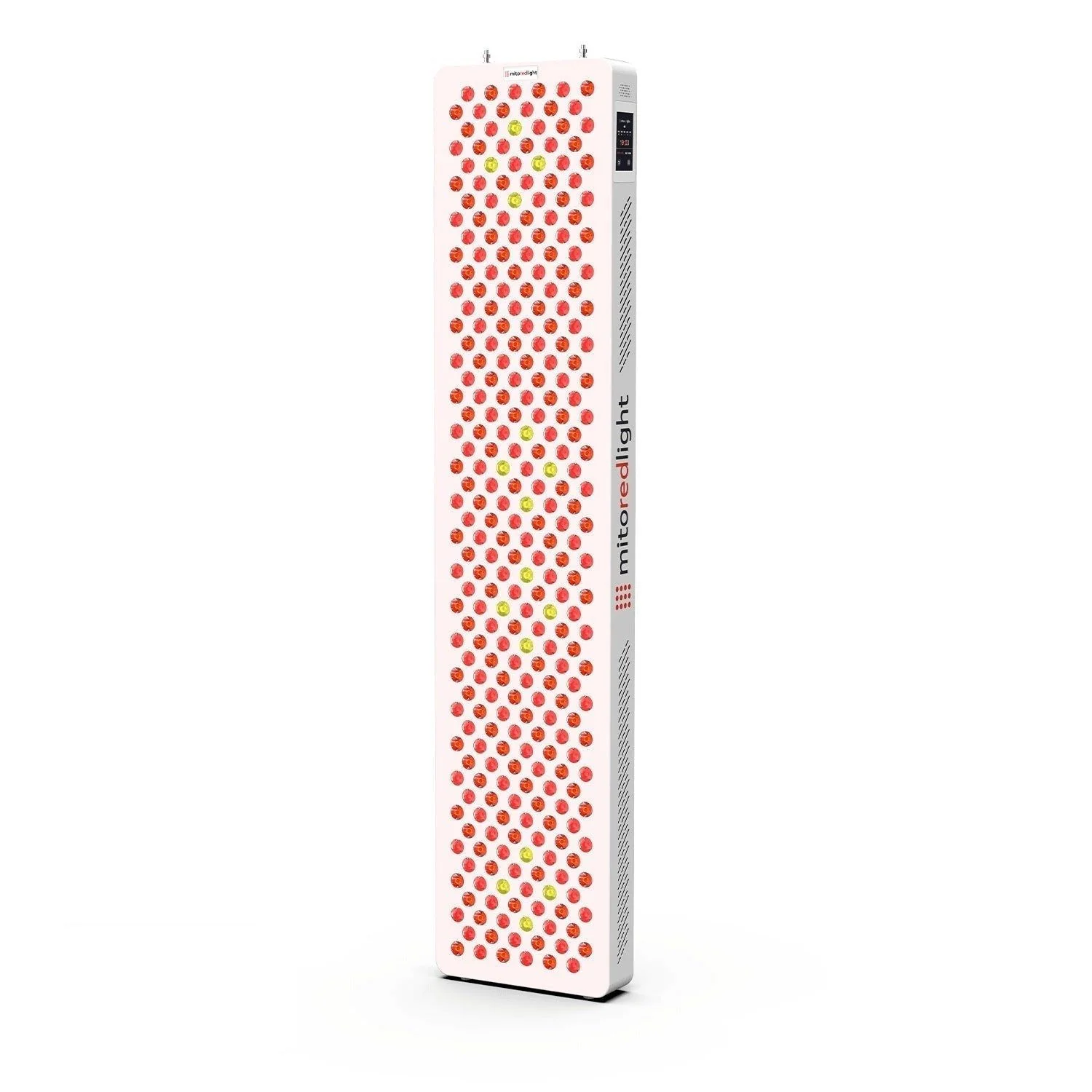
| - LEDs: 300 lenses with 600 chips. Mito says each lens holds two chips on separate circuits
- Wavelengths: 590, 630, 660, 810, 830 and 850 nm. Mito gives the split as 6%, 22%, 22%, 17%, 17% and 17%
- Modes and dimming: The touchscreen runs all six wavelengths (half red and amber, half near infrared), red and amber only, or near infrared only. The manual says red and near infrared each dim from 1 to 100%. The app adds NIR Extend: up to 20 minutes of near infrared with a 1-minute red break every 4 minutes
- Irradiance at 6 in: Mito lists >73 mW/cm² by professional spectroradiometer and >160 mW/cm² by consumer meter. The lab report Mito summarizes gives 53.5 mW/cm² average and 72.5 mW/cm² peak. Mito publishes no figure for any other distance
- Power: Mito lists 445 W. The lab measured 418.7 W at the wall. Input voltage isn't stated
- Size and coverage: 10 x 43 in and 25 lb. Mito rates it for full body, and the smaller 750X for upper or lower body
- Controls: Touchscreen with session timer, brightness control and alarm. One panel connects to the phone app by Bluetooth, and Mito's App Store listing shows the app as free with no in-app purchases. Running several panels together takes a wireless remote, which Mito includes only with 2- and 4-panel arrays
- Use guidance: 10-minute sessions at 12 to 18 in, at least 6 hours apart on the same area. The manual says 4 to 6 sessions a week, and the product page says 4 to 7. Mito advises no more than 15 minutes and never over 20. It gives the near-infrared-only cap as both 5 and 10 minutes
- In the box: Panel, power cable, user manual, over-the-door hook, steel hanging cables, 4 vinyl straps, opaque goggles and Mito Red IR3 glasses
- EMF and flicker: Mito says the panel emits 'no detectable EMF' at 6 in or more and is flicker-free, but publishes no measurements. The manual's only flicker entry, IEC 61000-3-3, tests the panel's effect on mains power, not light flicker
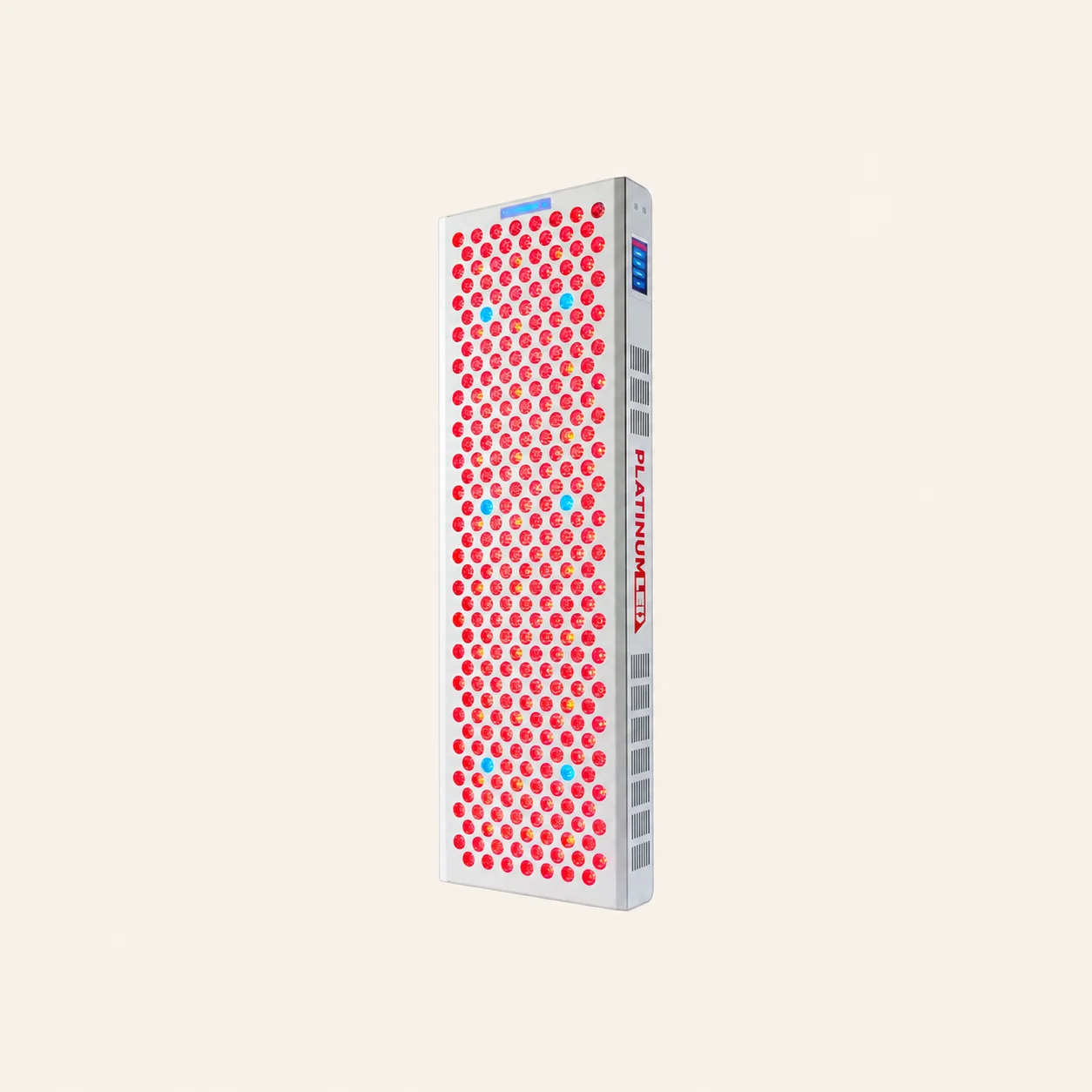
| - LEDs: 300 LEDs. LightLab's report lists 144 red, 150 infrared and 4 blue, which adds up to 298
- Wavelengths: 480, 630, 660, 810, 830, 850 and 1060 nm in the store description. The comparison table says "7 Wave" but lists only six, leaving out 850 nm
- Irradiance: None published for the 900 at any distance. The chart and "3rd Party Verified" report under it are for the BIOMAX PRO ULTRA. The 900's own LightLab test measured total output in an integrating sphere, not irradiance at a distance
- Power: 490 W and 4.4 A at 110 V in Solo mode. 380 W and 3.45 A in Remote mode. LightLab measured 490.9 W at 119.7 V
- Size and weight: 35.83 x 11.81 x 2.76 in, 33 lb. Maximum heat rating 130°F (55°C)
- In the box and mounting: Panel, eye protection, door hook, hanging bracket, power and patch cables, cable assembly with snap links, six screws, a wrench and a simple remote. Wall bracket $79 and stands $139 to $869, sold separately. None names the 900
- Use guidance: The product page says 10 to 20 minutes per area, up to 2 to 3 areas a day, 3 to 5 times a week. It gives 8 to 14 in for deep tissue and 16 to 24 in for the face. The FAQ says 10 to 15 minutes at 6 to 12 in for deep tissue
- EMF and flicker: PlatinumLED lists 0.0 µT at 4 in. The only test it describes used an unnamed EMF detector. It makes no flicker claim
|
|---|
| Exact variant | Single panel, sold as the PRO1500 in one configuration, with door mount and hanging kit, no stand | single 10 by 43 inch panel, with over-the-door hook and hanging cables, no stand | single full-body panel, with door hook and hanging bracket; no stand |
|---|
| Dimensions | 36 x 8.6 x 3.1 in and 21 lb, per Hooga's comparison chart and the table on its product page. Hooga's online store lists a weight of 13,154 g (about 29 lb) without saying whether that includes packaging. | 10 x 43 in (width x height, panel only) and 25 lb. Mito says to add about 6 to 8 in to the height on a floor or universal stand. It doesn't state the depth. Mito's lab-test table lists the panel as 42 x 9 in instead, without explaining the difference. | 35.83 x 11.81 x 2.76 in and 33 lb, per PlatinumLED's comparison table. |
|---|
| Installation | A door mount and a hanging kit with an adjustable pulley come in the box. The manual says to hang the kit and panel from the door mount, then plug the panel into any outlet. Mobile stands are sold separately. Input is AC 85–265 V, and no dedicated circuit or electrician is described. | An over-the-door hook, steel hanging cables and four vinyl straps come in the box. The manual shows how to hang the 1500X from a door but gives no weight limit for the hook. Mito's floor stand ($139) and universal vertical or horizontal stand ($349) fit the 1500X but cost extra. The panel plugs in with the supplied 16 AWG cord. Mito doesn't state input voltage, current draw or outlet needs. The only electrical rating in the manual is the 10 A, 250 V fuse. The manual gives an operating range of 45°F to 115°F. | The door hook and hanging bracket come in the box, and PlatinumLED's FAQ mentions an included over-the-door hanging kit. Stands cost extra, stand sales are final, and no stand listing names the 900. The Mobile Floor Stand ($139) fits "BIO and BIOMAX panels" but tells you to check its weight capacity, which isn't published. The wall bracket ($79) and four other stands say "BIOMAX panels only". Those stands run from $219 for the XL Mobile Floor Stand to $869 for the XL Motorized Horizontal Stand. The 900 draws 4.4 A at 110 V in Solo mode, and PlatinumLED says its lights also run on 220 V. |
|---|
| Materials | Not stated by the manufacturer. | Not stated by the manufacturer. | LightLab's report describes a formed steel housing, an aluminum circuit board mounting plate and four fans above the LEDs. Each LED has a clear conical plastic optic. |
|---|
| Warranty | Three years on the PRO1500, per the product page, the store listing and the manual. The manual counts the three years from delivery and says the warranty covers all parts and labor. Hooga's warranty page says coverage starts on the date of purchase, with no activation step. Abuse, misuse, modification, drops and non-Hooga parts aren't covered. If Hooga needs the panel back, you pay to ship it. Claims go by email to contact@hoogahealth.com. | Three years on MitoPRO X panels, starting on the delivery date. It covers defects in material or workmanship under normal use, for the original purchaser only. Negligence, improper maintenance, modification, theft and loss aren't covered. Mito doesn't repair panels or supply parts. It replaces eligible units, and you send back the whole product. Mito pays for the return label only in the first 180 days. Claims start by email to info@mitoredlight.com, and Mito may ask for photos or video of the defect. | Three years. PlatinumLED's warranty page says it runs from the delivery date in one place and from the purchase date in another. The refund policy says purchase. It covers a light that isn't working properly. PlatinumLED decides case by case whether to send parts, troubleshoot by phone or email, or replace the unit with a new or refurbished one. Claims need photo or video evidence. Drops, misuse and opening the panel aren't covered. Only the original buyer from PlatinumLED or an authorized reseller is covered. Neither page says who pays shipping on a claim. |
|---|
| Returns | 60 days from delivery. The panel must be in the condition you received it, in its original packaging. Returns aren't free: Hooga deducts the return shipping cost from your refund once it receives the item. US customers can print a prepaid label at Hooga's discounted rates. The policy also says 'open-box items cannot be refunded'. It doesn't say whether that covers any panel you've unboxed during the 60 days or only units sold as open-box. Items that aren't in original condition, or come back after 60 days, get only a partial refund. Approved refunds go back to the original payment method within 3 to 5 business days. | 60-day trial from delivery, with no restocking fee. The return must be postmarked within the 60 days and go back in the original packaging. You pay return shipping unless you added Free Returns & Package Protection at checkout. Mito doesn't state that option's price. Shipping fees and the protection fee aren't refunded. Shipping damage must be reported within 10 days of delivery. | 60 days from delivery, for the panel only. It must arrive back at PlatinumLED by day 60, in its original packaging with all accessories. Elective returns carry a 20% restocking fee, which is $259.80 at list price. You pay return shipping, and original shipping isn't refunded. Stands and accessories such as remotes are final sale. You need a return authorization by email first. The refund policy says refunds are processed within 14 days of receipt or proof of return shipment. |
|---|
| Unresolved questions | - How the irradiance figures were measured, and with what instrument
- Actual wall power draw, given the 530 W and 300 W figures
- How output splits between red and near infrared
- Housing material
- The door mount's weight rating
- Fan noise
- What return shipping costs for a 21 lb panel
- Whether 'open-box items cannot be refunded' applies to a panel you've unboxed and tried
- Which models the scanned FCC, CE and RoHS certificates name
- The FDA listing record itself, which Hooga shares only on request
| - Irradiance at the recommended 12 to 18 in
- Input voltage and plug type
- Panel depth and housing material
- Fan noise
- Measured light flicker and EMF
- The price of the optional return protection
- Whether the wireless remote is sold on its own, and its price
- The door hook's weight limit
- Whether the near-infrared-only cap is 5 or 10 minutes
- Which standards UL's medical equipment listing covers
- Why the lab-test table lists 42 x 9 in and only 660 and 850 nm
- The spectroradiometer model behind the lab figures
| - Irradiance at any distance
- Whether the simple remote's "full power" means 490 W or the 380 W Remote mode
- Which stand can carry a 33 lb panel, since no weight limits are published
- Who pays shipping on a warranty claim
- Whether the warranty starts at purchase or delivery
- US shipping cost, since the store says free and the shipping page gives no price
- Fan noise
- Whether the light flickers
- Peak wavelengths, since the lab report gives none
- What the scanned ETL and CB documents for the 600 and 900 actually cover
|
|---|