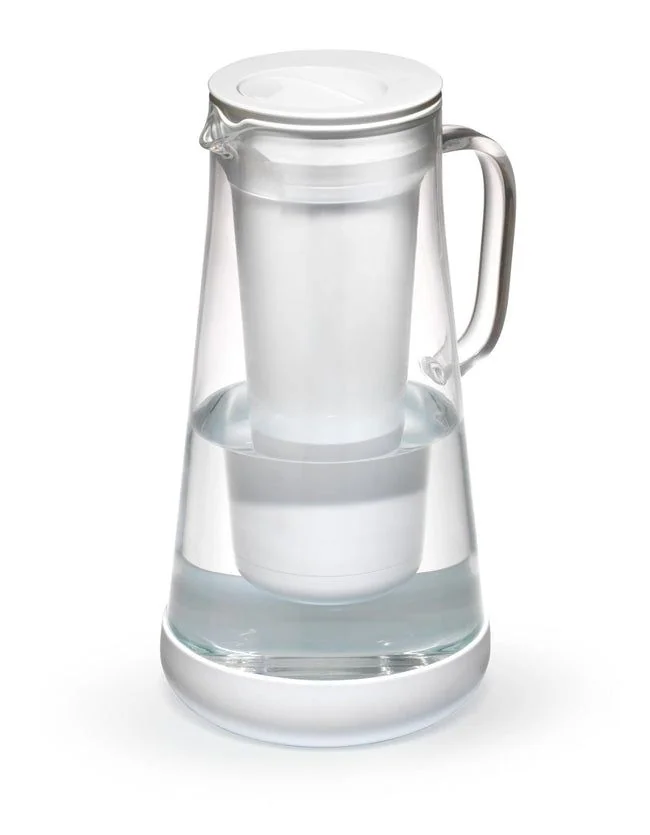
The LifeStraw Home 7-Cup Glass is a glass water filter pitcher with WQA-certified lead, cyst and microplastics reduction. It suits one or two people on city water, and a year of filters costs $75.95 in LifeStraw's 1-year pack. The catch is a carbon filter rated for only 40 gallons, and the PFAS and bacteria claims are lab-tested, not certified.
The trade-off
The carbon filter lasts only 40 gallons, and the PFAS and bacteria results aren't certified.
No affiliate commission on this link. Check the exact variant before buying.
About this price
List price on LifeStraw's US product page on Oct 13, 2026, before tax and shipping. The price includes both filters and the silicone base. No sale price or crossed-out regular price was shown. All seven colors cost the same. LifeStraw's online store showed White, Juniper and Terrazzo in stock and the other four unavailable. Free shipping applies to lower-48 orders of $75 or more (one banner says "above $75"), and the page doesn't say what smaller orders pay.
A GOOD FIT FOR
You're one or two people on city water and want a glass pitcher with certified lead reduction.
You want a glass pitcher and drink a few glasses of filtered water a day
You're on treated city water and want certified lead and microplastics reduction
You want to keep the fluoride your utility adds
You want filters to cost under $80 a year
You rent or can't change the plumbing
THINK TWICE IF
Your household drinks more than about two-thirds of a gallon of filtered water a day
You're on well water or any water that may be microbiologically unsafe
You want PFAS reduction backed by certification rather than lab reports
You want fluoride removed
You want a full pitcher in a few minutes
What still needs checking
WQA's own directory couldn't be opened, so the certified claims rest on LifeStraw's data sheet and a third-party database
Whether the 11.25 in figure is the height, since the axes aren't labeled
What shipping costs on orders under $75
How much filtering slows as the filters near the end of their life
How it handles PFAS other than PFOA and PFOS
How long unused spare filters keep
How the bacteria claim was tested, since LifeStraw's published reports don't include a bacteria test
Whether the older lab reports, which name a 7-cup BPA-free pitcher or a generic Home pitcher, tested the glass model
The practical details.
Specifications for LifeStraw Home 7-Cup Glass
Exact variant
7-Cup Glass, White
Capacity
7 cups (56 oz, 1.65 L) of filtered water in the carafe
Filter life
Carbon + ion exchange: 40 gal (150 L), up to 2 months; membrane: 264 gal (1,000 L), up to 1 year
Certification
WQA, to NSF/ANSI 42, 53 and 401; not listed by NSF
About 20 to 25 minutes per full reservoir once broken in
Daily limit
2 gallons a day for best filtration
Size and weight
11.25 × 5.8 in (axes not labeled); 2 lb 4 oz
Dimensions
LifeStraw lists it as 11.25 × 5.8 in (28.5 × 14.7 cm) without saying which figure is the height. It weighs 2 lb 4 oz (1.8 kg). The carafe holds 7 cups (56 oz, 1.65 L) of filtered water, and the water in the filter housing is extra.
Materials
LifeStraw says the pitcher is hand-blown, food-grade borosilicate glass on a silicone base. The filter housing and other plastic parts are BPA-free. The membrane microfilter is polysulfone with a 0.2-micron pore size. The second filter combines activated carbon and ion exchange.
Before you buy
InstallationNone
None. You fill it from the tap. Before first use, rinse the housing, wash the pitcher and fit the carbon filter. Then filter one fill and pour it away. The manual gives 2 gallons a day as the limit for best filtration. It also says to keep it away from heat above 140°F and from freezing.
WarrantyLifeStraw covers its products and parts for 3 years against defects…
LifeStraw covers its products and parts for 3 years against defects in materials and workmanship. Carbon filters get 60 days. Normal wear and tear, breakage and damage from dropping aren't covered. Refunds are only for purchases from LifeStraw.com. Products bought elsewhere qualify for replacement only. Claims go to info@lifestraw.com with the model number, at least two photos and proof of purchase.
ReturnsUnused items in their original condition can be returned within 45 days…
Unused items in their original condition can be returned within 45 days of delivery with proof of purchase. LifeStraw sends a free return label for eligible returns in the lower 48 states. Items bought with a discount, a promo code or in a bundle may not qualify. Original shipping isn't refunded, and any restocking fee is deducted. Refunds go out 7 to 10 business days after inspection.
More about this assessment
The LifeStraw Home 7-Cup Glass is a hand-blown glass pitcher with a 0.2-micron membrane and a carbon and ion-exchange filter. It costs $64.95, and a year of filters is $75.95 in LifeStraw's 1-year pack. A third-party database reports WQA certification under NSF/ANSI 42, 53 and 401 for lead, cysts and microplastics. The PFAS and bacteria results are lab-tested, not certified. The catch is a carbon filter rated for only 40 gallons, which lasts two months only at about two-thirds of a gallon a day. The 3-year warranty excludes breakage and drops, which matters for glass.
Strengths on paper
The pitcher is hand-blown borosilicate glass, and the glass is dishwasher safe
WQA certifies its lead, mercury, cadmium, copper and cyst reduction under NSF/ANSI 53
WQA certifies microplastics and nine emerging compounds, including bisphenol A, under NSF/ANSI 401
A year of filters costs $75.95 in the 1-year pack
In lab tests PFOA and PFOS combined fell from 1.5 to 0.01 µg/L or less
The 0.2-micron membrane is a second stage that LifeStraw says removes bacteria and parasites
LifeStraw publishes the lab reports behind its lead, mercury and PFAS results
Everything except the carbon filters has a 3-year warranty
Limitations
It holds 7 cups, and a full reservoir takes about 20 to 25 minutes
The carbon filter is rated for just 40 gallons
PFAS, bacteria, parasite, VOC and pesticide results are lab-tested, not certified
LifeStraw says not to use it on microbiologically unsafe water without disinfection, despite the bacteria claims
The product page calls 99.999% microplastics removal WQA certified, but the data sheet's certified figure is 99.0%
NSF's drinking water directory doesn't list it
The warranty excludes breakage and drops
Carbon filters have only a 60-day warranty
Only unused items can be returned, so you can't send it back after trying it
Free shipping needs a $75 order, more than the pitcher costs
The lid is hand-wash only
It doesn't remove fluoride, and LifeStraw doesn't test or certify it for TCE
What it costs to own.
Adjust the assumptions for your use. Missing costs stay unknown.
PLAN YOUR OWNERSHIP COSTS
What will it cost to own?
Change the assumptions to fit your use. Leave an unknown cost blank. Add water, subscriptions, cleaning, shipping and taxes if they apply. Use average operating power, not the maximum rating.
3-year planning total
$292.80
Every field has a value. This is an estimate, not a quote.
Energy component: $0.00
Purchase + installation + years × (annual consumables + annual other) + watts/1000 × hours/day × 365 × years × $/kWh. Annualized allowances, not an exact replacement schedule. Excludes taxes, shipping, finance and resale unless entered.
Replacement parts & cost assumptions
Recorded recurring parts and refills:
Activated Carbon + Ion Exchange Filter: $16.95 every 2 months. Rated for 40 gallons (150 L) or 2 months, whichever comes first. A 6-month pack of three is $39.95. A subscription sends one every two months for $14.95, with no shipping fee in the US. The manual says to replace it after more than two months unused.
Membrane Microfilter: $24.95 every 12 months. Rated for 264 gallons (1,000 L) or 1 year. The 1-year pack, $75.95, holds one membrane and six carbon filters. A used membrane that freezes has to be replaced.
Purchase is the $64.95 list price on Oct 13, 2026, before tax and shipping.
LifeStraw's schedule is one membrane and six carbon filters a year. Its 1-year pack holds exactly that for $75.95.
Bought one at a time, the same filters come to $126.65 a year: six carbon filters at $16.95 and one membrane at $24.95.
The subscription sends a carbon filter every two months for $14.95. That's $89.70 a year, plus $24.95 for the membrane.
The carbon filter's 40 gallons last two months only if you filter about two-thirds of a gallon a day or less. Heavier use means more filters.
No power, plumbing or subscription is needed, so energy and other yearly costs are zero.
With the 1-year pack, three years comes to $292.80 before tax and shipping.
Evidence & sources.
Do water filters work? Our evidence review grades the research as Strong. That grade is about the claim, not about this product.
Independent testA third-party filter database reports WQA listings for the LifeStraw Home Glass 7-Cup under NSF/ANSI 42, 53 and 401, checked Aug 30, 2026. Under 42 it lists chlorine, nominal particulate class I, and taste and odor. Under 53 it lists cadmium, copper, cyst, lead, mercury and turbidity. Under 401 it lists microplastics plus atenolol, bisphenol A, carbamazepine, estrone, linuron, meprobamate, nonylphenol, phenytoin and trimethoprim.3, 12 WQA's directory blocked automated access, so the listing wasn't opened directly. LifeStraw's data sheet marks the same claims as WQA certified. The database says the listings name the glass 7-cup and don't support extending them to LifeStraw's plastic pitchers or dispenser.
CertificationNSF's drinking water directory returns "No Matching Products Found" for the trade name LifeStraw and for the company name Vestergaard. The third-party database found no IAPMO R&T listing as of Aug 30, 2026.12–15 IAPMO's directory showed no search or listings when fetched, so the IAPMO result rests on the third-party database.
Manufacturer claimLifeStraw's data sheet for the glass 7-cup gives the WQA-certified results. Lead fell from a 0.15 mg/L challenge to at most 1.7 µg/L (98.9%). Cadmium fell 98.9%, copper 96.7% and mercury 82.9%. Cysts fell 99.996%, chlorine at least 97% and microplastics at least 99.0%.3, 4 These are results at the standard's challenge levels, not measurements of your tap. The certified capacity is 40 gallons, the carbon filter's life. The lead and mercury reports came from NSF International's lab in 2020, at pH 6.5 and 8.5. Lab testing at NSF isn't the same as an NSF listing.
Manufacturer claimLifeStraw's published reports show PFOA plus PFOS fell from a 1.5 µg/L challenge to at most 0.01 µg/L, against a 0.02 µg/L limit. QFT Laboratory ran the test in 2019 under NSF P473 section 7 and sampled to 200% of a 150 L capacity. The data sheet also lists lab results for benzene, styrene, toluene, xylenes, atrazine, lindane and glyphosate.3, 4 The data sheet marks these as independently tested, not WQA certified. The product page's FAQ says PFAS reduction is above 99%, but only PFOA and PFOS have published results.
Manufacturer claimThe data sheet reports 99.999999% bacteria and at least 99.999% parasite reduction for the membrane and says it meets NSF P231 and US EPA standards. The product page calls it the only pitcher independently tested to remove bacteria and parasites.1, 3, 4 Not WQA certified. LifeStraw's published test reports don't include a bacteria test. The parasite figure matches a 2021 test with 3-micron microspheres, not live parasites, which found about a 5-log reduction. The same data sheet says not to use it with water that is microbiologically unsafe or of unknown quality without adequate disinfection.
Manufacturer claimThe product page says the pitcher is WQA certified to remove 99.999% of microplastics. The data sheet lists the WQA-certified microplastics result as at least 99.0%, against an 85% requirement.1, 3 Go by the data sheet's 99.0% for the certified figure.
About this review. The facts on this page come from manufacturer pages, certification listings and independent tests, checked Oct 13, 2026. The sources are listed above.